
In setting up GenSeM, we listed a number of activities that we wanted to organise. Among those was to create a constructive and committed space where members could present their work done in the field of Migration, Gender and Sexuality. In this spirit, we launched the GenSeM Migration Dialogues on October 21st, 2020.
In this highly successful first Dialogue, Professor Eleonore Kofman and Dr Tanja Bastia discussed how we can decolonise gender and migration. Taking Eleonore’s latest work, recently published in Comparative Migration Studies, on decolonizing the field of gender and migration as a starting point, we discussed what it may mean, how it could be done, by whom, and for whom.
We were joined by over 100 people and colleagues could join us from Japan, Pakistan, Italy, Netherlands, Norway, the UK, among others. We engaged in a conversation about who produces knowledge about gender and migration, how that knowledge is circulated, what we are missing out (unwittingly, perhaps) in using Western understandings of gender and intersectionality, what types of migration are deemed worthy of study.
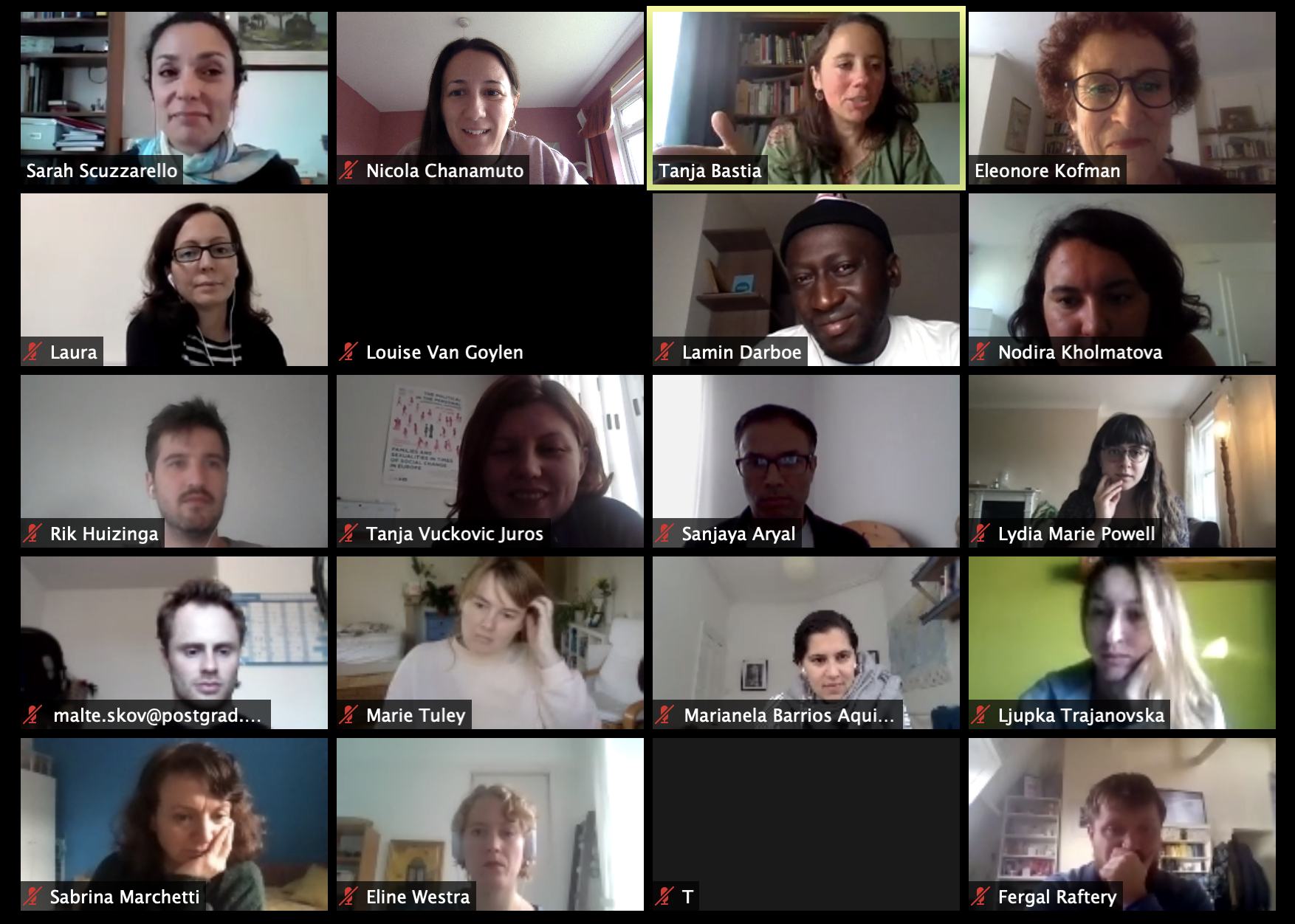
One of the key questions we discussed at length was how can we unsettle the current status quo in gender and migration research? Many suggestions were made by the presenters and the audience. Among those, to look at the early works in the field, which gave more prominence to theoretical and empirical scholarship outside Europe and North America, to incorporate more proactively research written in other languages than English, and to establish more horizontal, small-scale collaborations with non-Western colleagues.
We all agree that how to decolonialise the field of gender and migration is not a task that will be addressed in one seminar and we are keen on keeping the momentum going. Therefore, we will organise other activities around this theme in the near future. In the meantime, both Eleonore and Tanja have kindly shared the readings and names of organisations they referred to in their presentations. These can be found here.
If you would like to join us in this conversation, join our email list by contacting us at
In the meantime, a wholehearted thank you to Tanja and Eleonore for sharing their thoughts, and to the audience for their insightful comments.