
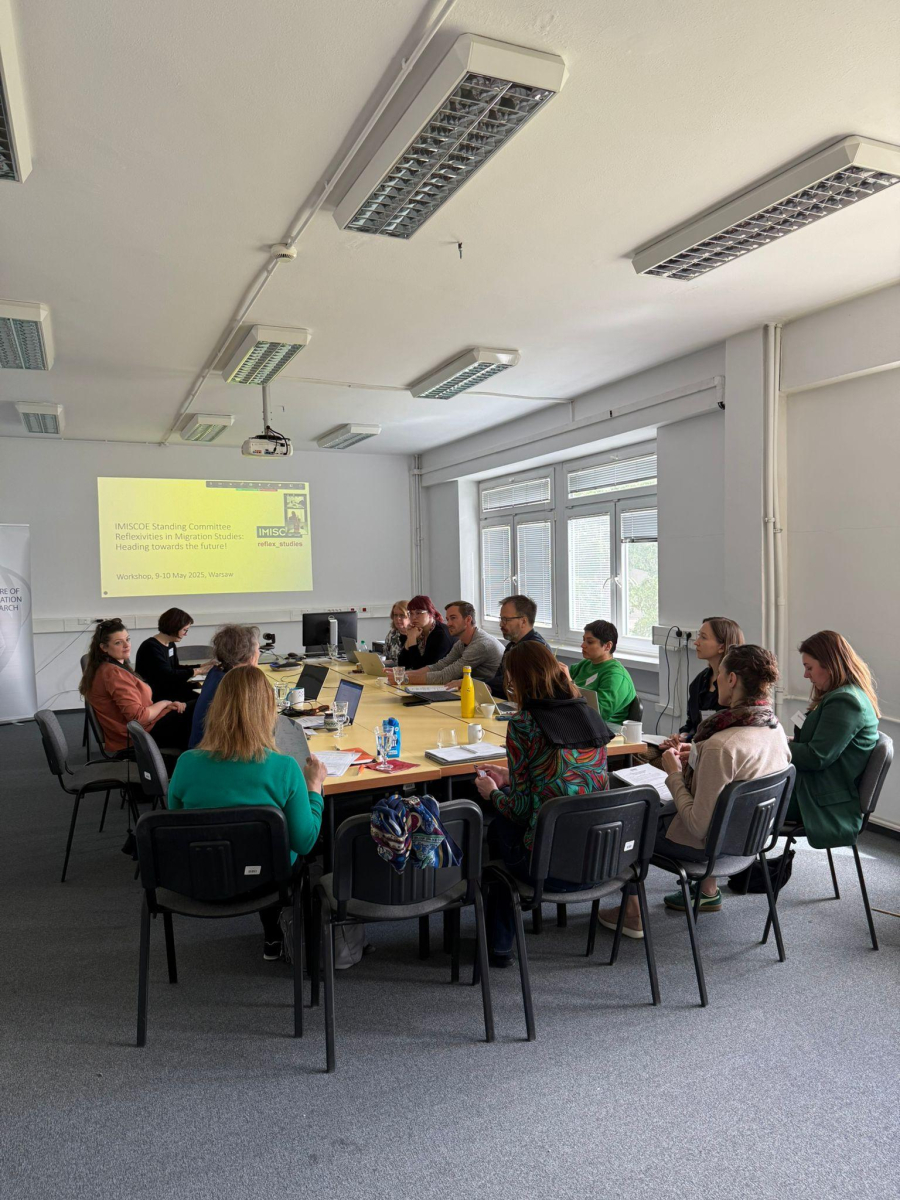
Five years after the kick-off meeting in Neuchâtel formally launched the work of the IMISCOE Standing Committee (SC) Reflexivities in Migration Studies, members gathered in Warsaw to take stock and formulate a future agenda. The workshop ‘Heading towards the future!’ took place on 9-10 May 2025 in Warsaw. It gathered most SC board members as well as several critical friends (with Anna Amelina and Kudakwashe Vanyoro as special guests), who had the difficult task – as outside observers yet involved in reflexive migration research in different ways – of helping the board to critically reflect on the committee’s achievements and explore future trajectories for reflexivity in migration research.
By fostering dialogue among established and emerging scholars, the workshop sought to:
- Evaluate past and current reflexive practices in migration studies.
- Identify emerging theoretical and methodological priorities in the field
- Develop practical ways to enhance the place of reflexivity in research and public debate on migration.
Participants shared the impression that, over the past five years, reflexivity as a paradigm has gained increasing prominence within the migration research community. This shift is evident in several developments, such as making reflexivity the central theme of the 2024 IMISCOE conference and the establishment of a professorship in Reflexive Migration Studies at a German university. Gathering in a context markedly different from that of five years earlier – not least in light of the important contribution of the SC towards destabilizing foundational concepts in the field such as ‘integration’ and ‘migrant’— participants raised the ‘what next?’ question. Collectively, they drafted the following future priorities:
- A future research agenda, retaining the focus on knowledge production and its entanglement with power relations, but rearticulating it more explicitly through the ideas of double reflexivity and reflexivity as practice. This work will involve turning the gaze inwards by addressing the structural conditions of doing reflexive knowledge and the mainstreaming (including instrumentalization and tokenization) of reflexivity.
- A future activities agenda to expand the work of the SC by examining the following themes, for each of which a specialized working group was established:
- Teaching reflexivities
- Increasing collaborations within and beyond IMISCOE
- Develop alternative visions on migration (research)
- Examine the link between reflexivities and activism, i.e. social justice struggles
- A newsletter to inform of current and future activities (subscribe here)
- Adopting an ethics of care within the work of the SC, that emphasizes the role of the SC as a supportive platform for doing reflexive migration research.
Overall, the workshop reaffirmed the need for more reflection on the nature of migration-related research and its societal and political implications. Migration studies has evidently changed as a field in the past years, adopting a more critical discourse, developing more self-awareness of its implications with power and opening way for broader themes that had been marginal (such as racism and coloniality). However, it remains true that ‘migration’ is more politicized than ever, and a hostile political climate dominated by far right discourse makes it a central issue of public contestation. In this charged socio-political context, the role of scholarly communities in the public debates on mobility and diversity needs to be accounted for. This is the task that the SC Reflexivities will continue to focus on in the coming years.
As a final note, the workshop formalized the change in the leadership of the SC. By the end of 2025, the current co-directors Janine Dahinden and Andreas Pott and the current coordinator Anna-Lisa Müller will step down from their positions, convinced that after these first five years of the SC it is now time for new perspectives and people to lead the SC. Andreas, Anna and Janine will all continue to work in the governing board. From January 2026 on, board members Nadine Blankvoort, Iva Dodevska and Stefan Manser-Egli will be the leading team.