
In 2009, when I first visited Shatila, a Palestinian refugee camp on the outskirts of Beirut, I was nineteen years old. I went there to volunteer in a Palestinian youth centre. In preparation for my trip, I had read extensively about the camp and its history: how it was founded after the Nakba in 1948, its entanglement in the Lebanese Civil War, and the massacre of Sabra and Shatila in 1982. I was prepared to encounter a “broken” place, marked by intergenerational trauma, dispossession and discrimination. Instead, I was confronted with my own ignorance.
At the time, I had studied filmmaking for one year and had decided to bring my camera with me to Lebanon. Out of a sincere belief that documentary cinema could reveal injustice, I wanted to investigate the living conditions in the camp, the history of Palestinian exile, and the political situation of Palestinians in Lebanon. But very quickly, when I started filming, I became uncomfortable with the images I was making. The camera did not simply record what was in front of me; it also reproduced an unbalanced relationship between me, a young filmmaker from Belgium, and the people I was filming. With every question I asked, with every image I framed, I felt I was pushing people who had welcomed me wholeheartedly into their homes into a role they already knew too well: the refugee, the victim, the witness of suffering. I decided never to use the images I made during that first visit.
In the years that followed, I kept returning to Shatila to visit the friends I had made, and one question kept returning: could cinema also be used to undo the roles it so easily produces? If the camera, and my initial approach, had pushed people into the fixed position of the victim, could filmmaking become a way of opening up other roles instead?
This question slowly led me towards using fiction within a documentary framework. Not fiction as an escape from reality, but as a method to approach reality differently. By creating fictional situations together with the people I filmed, they were no longer only asked to explain their lives to the camera: they could act, imagine, refuse, and shape the narrative from within. Working with them as actors, rather than documentary subjects, allowed us to share the production process as collaborators.
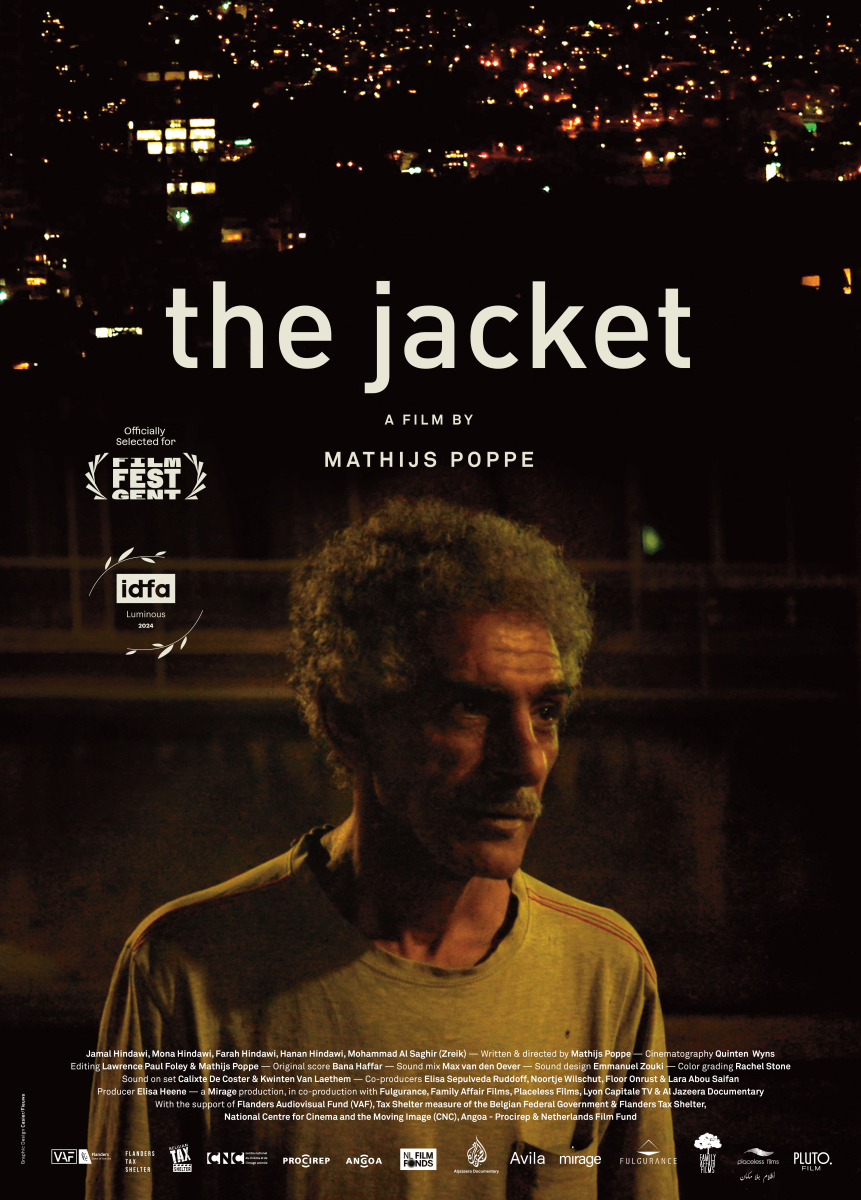
This method developed throughout the two films I have made in Shatila since. In Ours is a Country of Words (2017), we imagined a near future in which the long-awaited return to Palestine had become possible. The people in the film became actors preparing for a return they had grown up hearing about, dreaming of, doubting, and inheriting. In The Jacket (2024), this method shifted through the main character’s own practice as a theatre-maker. By following Jamal Hindawi during the production of a theatre play, he could appear not only as a Palestinian refugee, but as an artist, a father, a performer, and someone actively negotiating the history he has inherited. Fiction opened up a space in which fixed roles could be loosened and played with.
Looking back, I understand the introduction of fiction into the documentary framework as my way of approaching what filmmaker and theorist Trinh T. Minh-ha calls “speaking nearby” rather than “speaking about.” To speak nearby is not to disappear as a filmmaker, nor to pretend that the relationship is equal from the beginning. It is to create a form in which the people filmed or researched are not reduced to the knowledge we seek from them, but can help decide how they appear, from which role they speak, and what remains unresolved.
Mathijs Poppe (Belgium, 1990) is a filmmaker who developed close ties with the Palestinian community in Lebanon since his first visit to the Shatila refugee camp in 2008. In 2017, he graduated from the KASK School of Arts with his graduation film, Ours is a Country of Words. For his first feature film, The Jacket (2024), Poppe continued to deepen his collaboration with the Palestinian actor Jamal Hindawi and his family.
The Jacket is a portrait of Jamal Hindawi, a Palestinian man who lives in exile with his family in the Shatila refugee camp in Beirut, Lebanon. Together with his friends, he makes political theatre about their profound connection to their homeland, Palestine, and their situation as refugees in their country of residence, Lebanon. When Jamal embarks on a journey to search for an important lost theatre prop, he witnesses how the successive political and economic crises have disrupted an entire region and its people.