
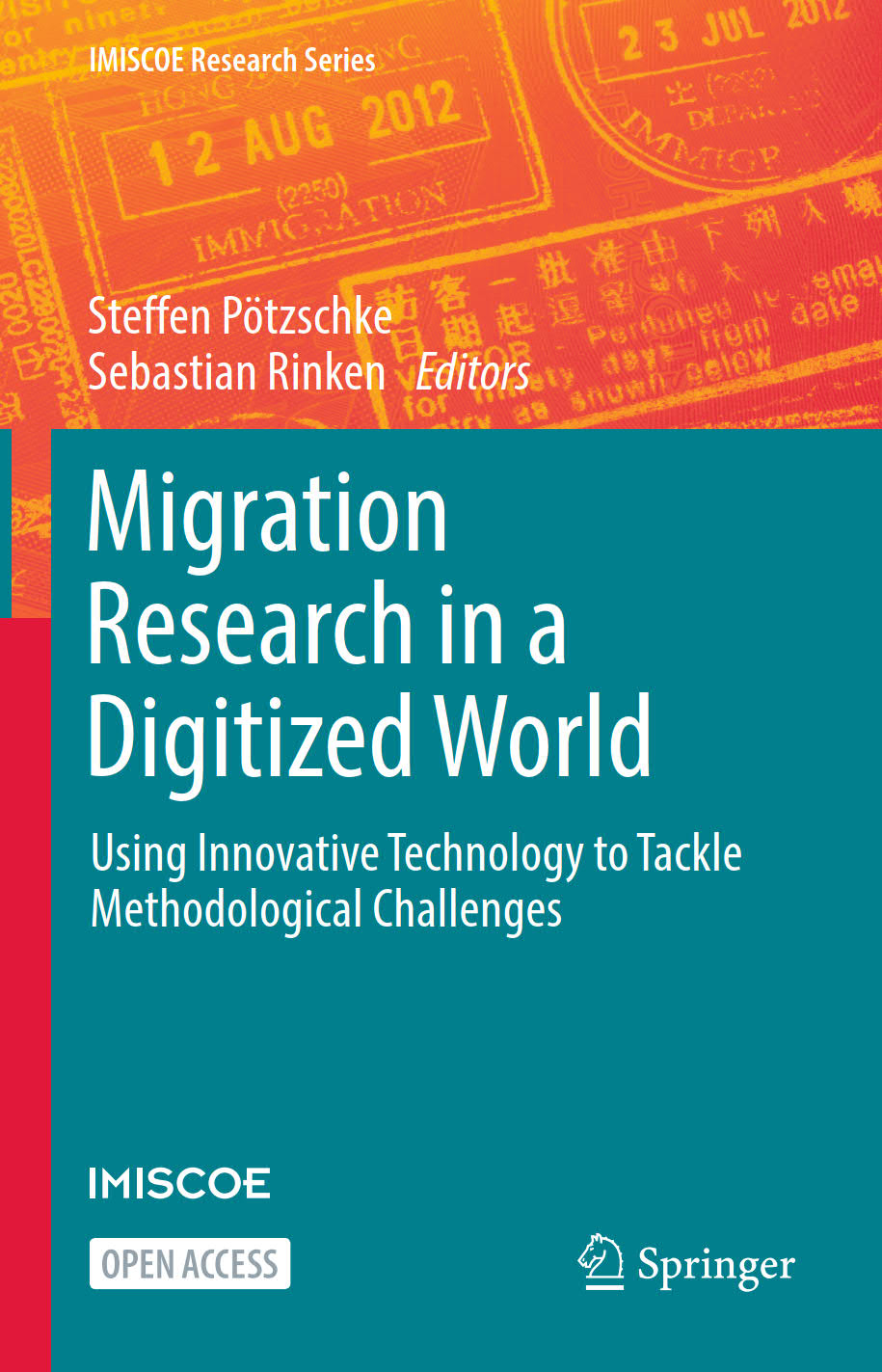
The collection “Migration Research in a Digitized World” edited by Meth@Mig members Steffen Pötzschke and Sebastian Rinken , is now available in open access and in print.
The book explores the implications of the digital revolution for migration scholars’ methodological toolkit. New information and communication technologies hold considerable potential to improve the quality of migration research by originating previously non-viable solutions to a myriad of methodological challenges in this field of study. Combining cutting-edge migration scholarship and methodological expertise, the book addresses a range of crucial issues related to both researcher-designed data collections and the secondary use of “big data”, highlighting opportunities as well as challenges and limitations. A valuable source for students and scholars engaged in migration research, the book will also be of keen interest to policymakers.
Content - Using Innovative Technologies to Tackle Methodological Challenges in Migration Research – Pötzschke & Rinken | Innovative Sample Designs for Studies of Refugees and Internally Displaced Persons – Eckman & Himelein | Targeting on Social Networking Sites (SNS) as Sampling Strategy for Online Migrant Surveys: The Challenge of Biases and Search for Possible Solutions – Rocheva, Varshaver, & Ivanova | Web-Based Respondent-Driven Sampling in Research on Multiple Migrants: Challenges and Opportunities – Górny & Salamońska | Computer-assisted Migration Research: What We Can Learn about Source Questionnaire Design and Translation from the Software Localization Field – Behr | Surveying Illiterates: Are Audio Files in Computer-assisted Self-interviews a Useful Supportive Tool? – Heinritz, Will, & Gentile | Leveraging the Web for Migration Studies: Data Sources and Data Extraction – Rinken & Ortega | How Canada’s Data Ecosystem Offers Insights on the Options for Studying Migration in an Unprecedented Era of Information – Ramos & Haan | Assessing Transnational Human Mobility on a Global Scale – Deutschmann, Recchi, & Vespe | Google Trends as a Tool for Public Opinion Research: An Illustration of the Perceived Threats of Immigration – Lorenz, Beck, Horneber, Keusch, & Antoun | Migration Research in Times of Ubiquitous Digitization – Rinken & Pötzschke