
Redefining Mobility through a Disaster in Portugal
Portugal recently faced one of the worst extreme weather events in living memory, as winds of up to 200 km/h completely devastated the central region of Leiria, where little or nothing was left standing, and people were forced to leave their homes behind, challenging the progressive understanding of climate-induced mobility in the Global North. In view of this post-natural disaster in Portugal, and the deepening of research over the last decade on climate-induced displacement under the umbrella concept of humanmobility in the context of climate change (HMCCC) (Oakes et al., 2023), reality demands a more profound reflection on the subject in a country where scientists argue that there are structural shortcomings in efforts to address the adverse consequences of extreme weather events (Freitas, 2026). Accordingly, to fully understand climate-induced displacement and decisions to stay, leave, or rebuild, we must look beyond infrastructure and science and consider the cultural and spiritual frameworks that shape how people interpret and navigate environmental stresses.
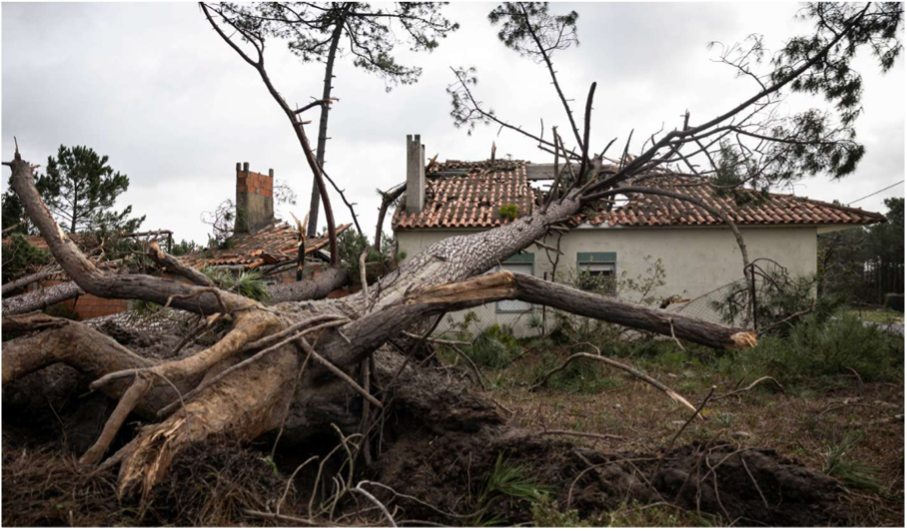
Figure 1 House roof destroyed by strong winds in Leiria; Source: Observador
“Comanded by God”: Faith amid Environmental Stress and Climate Perceptions
During the catastrophic winds and floods that struck Portugal in February, a radio broadcast featuring a resident of Leiria offered a powerful example of how environmental stress, immobility, and belief are interconnected. Despite losing electricity and seeing parts of her roof destroyed, this older individual was interviewed and spoke with a striking calm, drawing on a faith-based understanding of the world that helped her interpret the disaster and cope with the stress it created. Her words, quoting “these phenomena commanded by God,” reflected more than personal belief; they highlighted an important aspect of voluntary immobility. This perspective suggested that, in the Portuguese context, an environmental crisis is not just a logistical failure but also a matter of choice. By attributing the event's cause to divine will, the interviewee reframes a life-threatening climate event as a spiritual command, showing how religious beliefs can offer both a sense of order and psychological resilience. This adds a new dimension worth exploring in relation to climate-induced displacement.
In Marrakesh, rural communities facing severe drought and aridification often frame environmental degradation through a lens of spiritual destiny rather than mere ecological shift. Van Praag (2021) notes that this apparent acceptance of adverse conditions is rooted in the belief that such changes occur by the will of God. Rather than signalling complacency, this perspective reflects a profound religious contentment that shapes how these populations endure the distortion of their livelihoods.
Theocentric perceptions of climate change are evident in how faith defines nature in relation to God (Praag et al., 2021). As Portugal is a predominantly Catholic country, where the presence of faith remains alive, partly due to the ageing population, if everything happens according to God's natural law, we, humans, must accept these events and changes in our natural environment, for God, as the creator of the earth, knows how to provide the universe with the balance it needs (Praag et al., 2021). As such, the devout tend not to convey a fatalistic resignation in their discourse, but rather to use their belief as a way of giving meaning to the chaotic events and disorder affecting their livelihoods and damaging their homes, while those in power fail to provide the country, in this case Portugal, with the necessary infrastructure and early and effective crisis management (Lusa, 2025). In a moment of despair where the State does not act immediately, hope seeks faith to keep itself alive.
When Faith fills the void of Governance
Within the Portuguese landscape, state-level adaptation strategies need to go beyond short-term green investments and technical infrastructure to address an essential aspect of resilience: the cultural and spiritual. Today, top-down climate change awareness campaigns in Portugal often use specialized scientific language that fails to resonate with the beliefs of rural and older populations, who may interpret environmental decline through a religious or providential perspective. When faced with the need to implement adaptation measures, such as planned relocation projects, the State must bridge the gap between institutional science and local spirituality. Instead of trying to displace these belief systems—which can offer vital psychological and social support—the State should incorporate accessible climate communication into the existing cultural framework using everyday language. By encouraging community-led resilience that respects these spiritual beliefs, the Portuguese government can help ensure that the adaptation process is internally motivated, reducing the risk of social division amid increasing environmental challenges.
The environmental change perceived as a divine mandate may serve as psychological consolation, yet it simultaneously obscures the structural lack of preparedness within the Portuguese State as it confronts increasingly frequent and severe climate impacts. Such providential framing, where climatic outcomes are viewed as spiritually mandated, rather than as phenomena subject to secular intervention or state-led adaptation, finds a parallel with the findings in Morocco, whether unprecedented climate events such as extreme snowfall or flooding are interpreted through a lens of divine displeasure regarding human actions (Praag et al., 2021). In both contexts, attributing one climate event to a reaction against an interpreted, misguided human action by a higher power risks depoliticizing the climate crisis. By attributing these changes to a spiritual action, the urgent need for adaptation and resilience-building may become secondary to a narrative of spiritual endurance, potentially masking the current governance gaps that leave these communities more vulnerable to an increasingly constant future of environmental stress. As such, this dichotomy in the explanation of climate change between science and God demonstrates the complex navigation between environmental pressure and the internal belief systems, demanding a deeper understanding of the relation between environmental stress, immobility, and belief systems.
Bridging Science, Spirituality, and Adaptation Policy
Ultimately, the development of climate resilience, including adaptation mechanisms regarding climate-induced displacement, necessitates a synthesis of these diverse epistemologies. Rather than viewing providential beliefs and empirical science as mutually exclusive, a robust framework must bridge the gap between local ontological certainties and technical expertise, grounded in a model that fosters shared responsibility, ethical-moral frameworks, and scientific knowledge, and that convenes to effectively mediate environmental action as a whole.
References
Freitas, A. C. (2026, February 26). Cientistas apontam a Portugal falhas estruturais que agravam efeitos das tempestades. PÚBLICO. https://www.publico.pt/2026/02/26/azul/noticia/cientistas-apontam-portugal-falhas-estruturais-agravam-efeitos-tempestades-2166017
Lusa. (2025, July 7). Portugal investe no ambiente menos 1,6 mil milhões de euros do que é preciso. PÚBLICO. https://www.publico.pt/2025/07/07/azul/noticia/portugal-investe-ambiente-menos-16-mil-milhoes-euros-preciso-2139328
Oakes, R., Van der Geest, K., Schraven, B., Adaawen, S., Ayeb-Karlsson, S., de Sherbinin, A., Etzold, B., Groth, J., Hermanns, K., Lakeman, S., Nawrotzki, R., Rademacher-Schulz, C., Romankiewic, C., Serraglio, D., Sterly, H., Thalheimer, L., Wiederkehr, C., & Williams, D. (2023). A future agenda for research on climate change and human mobility. International Migration, 61(5), 116–125. https://doi.org/10.1111/imig.13169
Praag, L. van, Ou-Salah, L., Hut, E., & Zickgraf, C. (2021). Migration and Environmental Change in Morocco: In search for Linkages Between Migration Aspirations and (Perceived) Environmental Changes. Springer Nature.
Author's Bio
Filipa Saraiva is a PhD Candidate in Sociology of the State, Law, and Justice at the Faculty of Economics of the University of Coimbra and the Centre for Social Studies of the University of Coimbra, having been awarded a PhD scholarship from the Foundation for Science and Technology for the development of her research, and is carrying out her research between FEUC/CES and the Department of International Development at the University of Oxford. Her research involves exploring the migratory aspirations of young people amid environmental and ocean governance, using coastal communities in Cape Verde as a case study. In addition, in the professional field, she has acquired experience in diplomacy and external relations, as well as in executive education. She is currently a Board Member of the IMISCOE PhD Network.

Image Source: Observador https://observador.pt/;