
Language, Power, and Social Boundaries: Dynamics of Inclusion - Exclusion Across Social Spaces
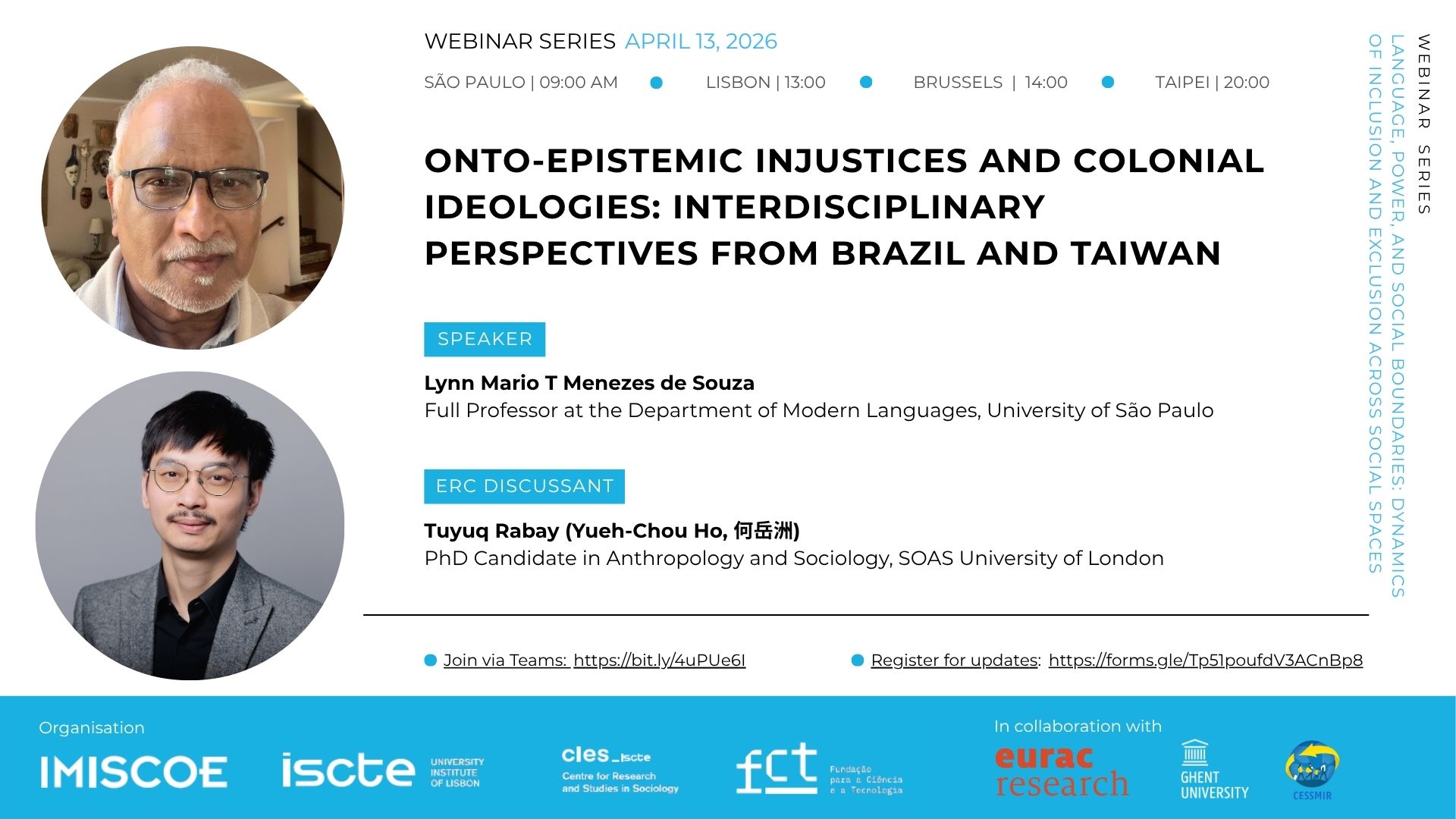
IMISCOE SC EduSocial & CIES-Iscte, in collaboration with Eurac Research & CESSMIR (Ghent University), are pleased to invite you to the second session of the Webinar Series “Language, Power, and Social Boundaries: Dynamics of Inclusion and Exclusion Across Social Spaces.”
This series brings together researchers and professionals from around the world to discuss innovative projects on language and power dynamics.
Following the success of our first two meetings, this third session on "Onto-epistemic injustices and colonial ideologies: interdisciplinary perspectives from Brazil and Taiwan" will feature:
- Prof. Lynn Mario T Menezes de Souza (University of São Paulo, Brazil)
- Discussant: Tuyuq Rabay (Yueh-Chou Ho, 何岳洲) (PhD Candidate, SOAS University of London, United Kingdom)
This event will take place on 13 April 2026, at 13:00 Lisbon time-GMT (09:00 AM São Paulo; 14:00 Brussels; 20:00 Taipei), online via WEBEX.
We look forward to seeing you there and engaging in this important discussion on how language shapes our social boundaries.
Register for updates: https://forms.gle/Tp51poufdV3ACnBp8
Join via Teams: https://events.teams.microsoft.com/event/476ba864-f5fb-4c94-800d-5c5b557d548a@92513267-03e3-401a-80d4-c58ed6674e3b
Lynn Mario Trindade Menezes de Souza is full professor in the Department of Modern Languages at the University of São Paulo, Brazil, where he teaches and supervises graduate work within the fields of Applied Linguistics and Post-Colonial and Decolonial Theories and Analysis. His research focuses on language policies, literacy, decolonial theories and practices and teachers’ education. His publications focus on his research themes with special emphasis on Global South contexts.
Tuyuq Rabay (Yueh-Chou Ho, 何岳洲) is a PhD candidate in Anthropology and Sociology at SOAS University of London and a doctoral candidate at the Institute of Ethnology, Academia Sinica, Taiwan. Drawing on his work in Atayal primary schools’ indigenous curriculum development and his personal indigenous connection, his research examines how Atayal children become “Indigenous educated persons” through Indigenous curricula, academic lessons, and kin-based caring networks in contemporary settler colonial practice Taiwan.